
Teaching
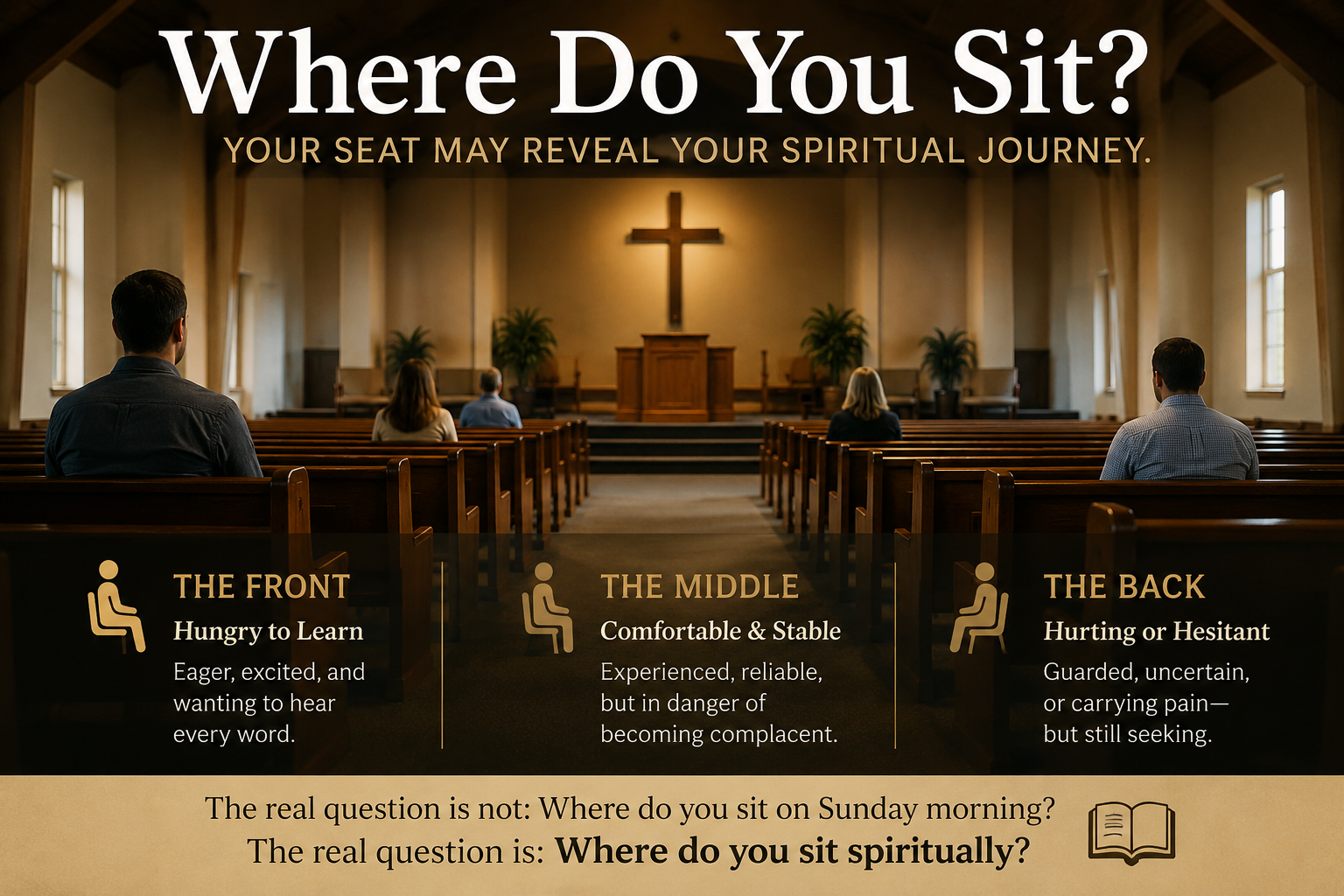
Years ago, while I was in college, I wrote a paper called "Where Do You Sit?" It began with a simple observation about where people chose to sit in church.
Most people do not walk into church every Sunday and carefully consider every available chair. They develop a habit. They find a section, a row, and sometimes even one particular seat that becomes theirs. Week after week, they return to the same place.
As I watched people, I began to wonder whether their seating choices revealed something deeper. Could the place a person chose to sit reflect something about where that person was spiritually?
That college paper eventually became more than an observation about church seating. It became a question about spiritual growth, spiritual distance, and the condition of the heart. This blog post is a reconstruction of that original idea, which later became the opening chapter of my book, 5 Stages of Spiritual Growth.
The People in the Front
New Christians often want to sit near the front.
They are excited. They are hungry. They want to hear every word and absorb everything they can. Their Bibles are open. They may be taking notes. They are listening because the message feels new, personal, and alive.
They know they have much to learn, and they are not ashamed of it.
There is something beautiful about the hunger of a new believer. They have discovered grace, forgiveness, and a relationship with God, and they want more. They are like newborn children craving nourishment because they understand that what they receive will help them grow.
The front row becomes a picture of spiritual hunger.
It represents the person who says:
"I do not want to miss what God is saying."
"I want to know Him better."
"I want to learn."
"I want to grow."
This is the spiritual infant stage—not as an insult, but as the beginning of a new life. Infants require care, nourishment, protection, and instruction. In the same way, new believers need biblical teaching, supportive relationships, encouragement, and spiritual parents who will walk beside them.
We should never look down on spiritual infants. We should celebrate them, nurture them, and learn from their hunger.
Sometimes those who have followed Christ for many years need to rediscover the enthusiasm they had when everything was new.
The People in the Back
Then there are those who sit toward the back.
They may arrive after the service begins and leave before anyone can speak to them. They want to be present, but they also want an easy way out. They may be physically inside the church while remaining emotionally and spiritually guarded.
Some are struggling with doubt.
Some are carrying guilt.
Some have been hurt by a church, a pastor, another Christian, or someone they trusted.
Some know they have drifted away from God but do not know how to return.
Others may not even be certain why they came. Something inside them simply would not allow them to stay away.
The back row can represent distance, but distance does not always mean rejection. Sometimes it represents uncertainty. Sometimes it represents pain. Sometimes it is the place where a person sits while deciding whether it is safe to hope again.
Sometimes the back row is not rebellion. Sometimes it is survival.
We must be careful not to judge the people sitting there. The person near the door may be fighting a spiritual battle no one else can see. It may have taken every ounce of courage they possessed simply to walk into the building.
The back row is still inside the church.
That matters.
The person sitting there has not completely walked away. They are still listening. They are still watching. Somewhere beneath the disappointment, fear, shame, or doubt, there may still be a small spark of hope.
They do not need people staring at them.
They need someone to notice them.
They do not need condemnation.
They need to be reminded of the love, mercy, patience, and grace of God.
God is not standing at the front of the sanctuary shouting, "Why are you so far away?"
He is inviting them closer.
Not necessarily closer to a pulpit, a platform, or a physical chair—but closer to His heart.
The People in the Middle
In the middle often sit the old-timers.
These are the people who have attended church for years. They know the songs. They know when to stand, when to sit, and when the sermon is almost finished. They know the language of the church and understand how everything works.
They are stable. They are dependable. They may serve, teach, lead, give, pray, and care for others.
There is tremendous value in that kind of stability.
However, stability can quietly turn into routine, and routine can slowly become complacency.
The middle seat can represent maturity, but it can also represent comfort.
A person may know the Bible without allowing the Bible to continue changing them. They may know how to attend church without truly expecting to encounter God. They may know the correct answers while no longer asking difficult questions about their own spiritual condition.
The danger is not sitting in the middle.
The danger is deciding that we have arrived and no longer need to grow.
Spiritual maturity is not measured by the number of years we have attended church. It is not measured by how many sermons we have heard, how many verses we can quote, or how familiar we are with church traditions.
Maturity is revealed by what our faith produces.
Are we becoming more loving?
More patient?
More forgiving?
More generous?
More willing to serve?
Are we helping other people grow?
At some point, spiritual maturity means turning around—not to see who arrived late, but to see who needs our help.
A mature believer should not remain focused only on what he can receive from the church. He begins to ask what he can give. He looks for the spiritual infant who needs encouragement, the spiritual child who needs guidance, the hurting believer who needs restoration, and the person in the back who needs someone to sit beside him.
The Seat Is Not Really the Point
Of course, we cannot determine a person's spiritual condition by where he physically sits.
Someone may sit in the back because of anxiety, hearing needs, young children, mobility concerns, or simply personal preference. Someone may sit in the front out of habit rather than hunger. Someone in the middle may be deeply engaged with God, while another person in the same row may be spiritually asleep.
This is not a system for judging other people.
It is a mirror for examining ourselves.
The real question is not:
"Where do you sit on Sunday morning?"
The real question is:
Where do you sit spiritually?
Are you leaning forward, hungry to hear from God?
Are you sitting at a safe distance because you have been hurt?
Are you present physically but absent emotionally?
Have you grown comfortable with a faith that no longer challenges you?
Are you always receiving, or have you begun giving?
Are you helping someone else move closer to God?
Your Seat Can Change
The encouraging truth is that your current seat does not have to become your permanent seat.
Spiritual growth is not always a straight line. There are seasons when we feel close to God and seasons when we struggle to hear His voice. There are moments of rapid growth and periods when we seem to stand still. Even mature believers can experience disappointment, weariness, doubt, or spiritual dryness.
A setback does not erase everything God has done in your life.
It simply reveals where you need His help again.
Perhaps you once sat at the front spiritually, full of expectation, but disappointment caused you to move backward.
Perhaps you have spent years in the middle, faithful but comfortable, and God is challenging you to become active again.
Perhaps you are a new believer who feels overwhelmed by everything you do not yet understand.
Wherever you are, God is not asking you to pretend.
He is asking you to take the next step.
If you are hungry, remain teachable.
If you are hurting, allow someone trustworthy to walk with you.
If you have become comfortable, ask God to awaken you.
If you are mature, begin investing in someone else.
If you feel far away, remember that God has not stopped reaching for you.
So, Where Do You Sit?
Take a moment and picture yourself entering the sanctuary.
Where would your heart choose to sit?
Would it move toward the front, eager and expectant?
Would it remain near the back, uncertain whether it is ready to trust again?
Would it settle into the familiar middle, grateful for stability but perhaps a little too comfortable?
God already knows where you are. He is not asking the question because He needs information. He is asking because we sometimes need help seeing ourselves honestly.
Where you sit today is not as important as the direction you are moving.
Are you moving closer to God?
Are you allowing Him to heal what has caused you to withdraw?
Are you continuing to learn, even after years of following Him?
Are you making room for someone who is just beginning?
Are you using what God has taught you to help someone else grow?
The Christian life is not about occupying the same spiritual seat forever. It is about continuing to move, learn, serve, mature, and become more like Christ.
So, where do you sit?
And more importantly:
Where is God inviting you to sit next?