
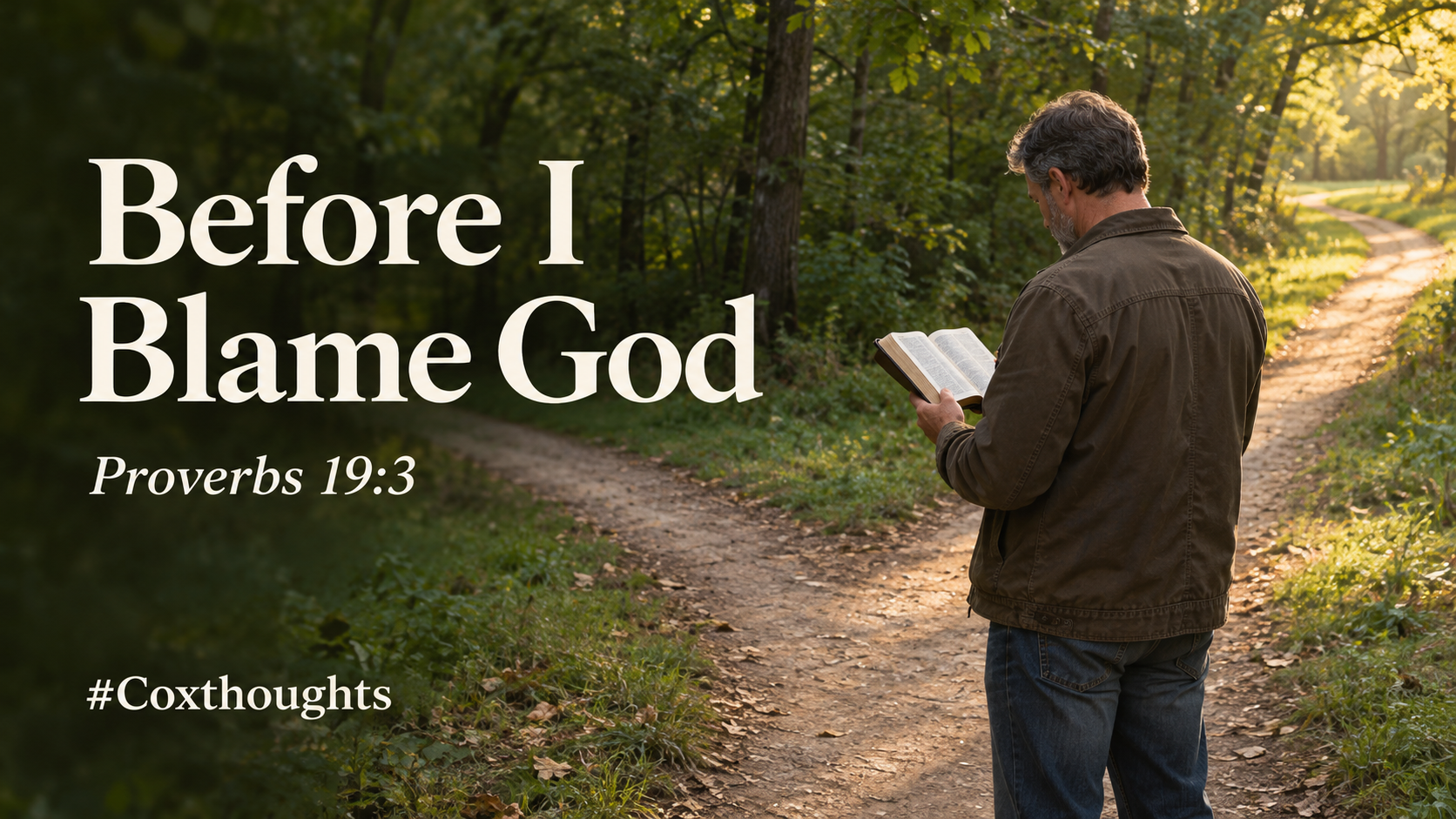
Before I Blame God
Teaching
By Kelly D. Cox
"The foolishness of a man twists his way,
And his heart frets against the LORD."
Proverbs 19:3, NKJV
It is easy to look at a hard season and ask, "God, why did You let this happen?" Sometimes that question comes from deep pain. Other times, I need to pause long enough to ask what my own choices had to do with where I am.
Proverbs 19:3 puts that question right in front of me. A man damages his own path through foolishness, then turns his anger toward the Lord. His choices helped create the trouble, but God gets the blame.
That is uncomfortable to read because it takes away an excuse. If my choices helped create the problem, I have a part to own.
There is suffering we never chose. Illness, loss, and harm caused by others can enter our lives through no fault of our own. We can bring our grief and hard questions to God. The issue in this proverb is blaming Him for damage our own foolish choices have caused. I need to apply that truth to my own life with honesty and approach other people's pain with care.
My choices have consequences
If I keep speaking in anger, those words will affect my relationships. I may regret what I said and pray for peace afterward, but the other person still heard it. They may need time before they trust me again. My regret does not erase what they experienced.
If I keep spending money I know I need for bills, I should look at those decisions when the bills come due. Asking God for help is a good place to turn, but I also need to face the choices that helped put me there.
Calling every consequence an attack from the devil can keep me from dealing with a habit I need to change. Blaming God can do the same thing. Whatever else I may be facing, I still have responsibility for the words I speak and the decisions I make.
It can be easier to explain why a choice seemed reasonable than to admit it was wrong. I can spend so much time defending what I did that I never stop to learn from what happened. Then I make the same choice again and wonder why the result looks familiar.
I need to read what God has said
The Bible gives me comfort when things go wrong, and it also challenges the thinking that can lead me into trouble. I need to open it with a willingness to learn, especially when what I read challenges something I want to keep doing.
I value good teaching, but I am still responsible for reading Scripture for myself. I need to consider a passage in context and give it thought. When I depend entirely on what someone else says, I can accept an explanation without ever checking whether the Bible supports it.
That matters when someone's explanation leaves me waiting for God to change something He has already told me to address. I can pray about a damaged relationship while avoiding an apology. I can ask for wisdom while refusing to listen to correction. I need to ask whether I am willing to follow the direction I already have.
James 1:22 calls us to put the Word into practice and warns that hearing it without acting on it can become self-deception. biblegateway.com
Reading matters, but finishing a chapter is only a start. If I read about patience and then excuse every angry response, I still have work to do. What I learn needs to reach the next conversation and the next decision.
My thinking needs to change
Romans 12:2 connects transformation with the renewing of our minds. biblegateway.com
For me, that means being willing to let God challenge the way I explain my own behavior. If I keep saying, "That is just how I am," I give myself a reason to continue. I stop asking whether the way I am acting needs to change.
Honesty sounds more like, "I was angry, and I chose words that hurt someone. I need to make that right." That admission gives me something to work on. I can acknowledge what someone else did while still taking responsibility for how I responded.
This takes humility because I may have to give up a story that makes me look better. I may have to listen when someone points out a pattern I have been defending. I may even need help seeing it clearly.
But if I want my life to change, I have to be willing to change. I cannot expect a different result from a habit I keep protecting.
I can take the next step today
Taking responsibility gives me something useful to do. I can return to a conversation and say, "I was wrong to speak to you that way." I can ask someone I trust to help me recognize a habit before I repeat it. I can read a passage of Scripture slowly and decide how I will put it into practice today.
Some consequences take time to work through. An apology may be needed today, while rebuilding trust takes much longer. People need to see changed behavior over time. Accepting that is part of owning what I did.
I believe I can bring my failures to God and ask for forgiveness and help. I can also accept the work of making things right where I am able. There is hope in being honest, because I can finally begin dealing with what needs to change.
Proverbs 19:3 leaves me with a question I need to keep asking: Where have I been blaming God for something I need to take responsibility for?
I cannot go back and make yesterday's decision again. I can be honest about it, learn from it, and take a better step now. Before I ask God to change my circumstances, I need to be willing to let Him correct my thinking and change my choices.
#Coxthoughts