
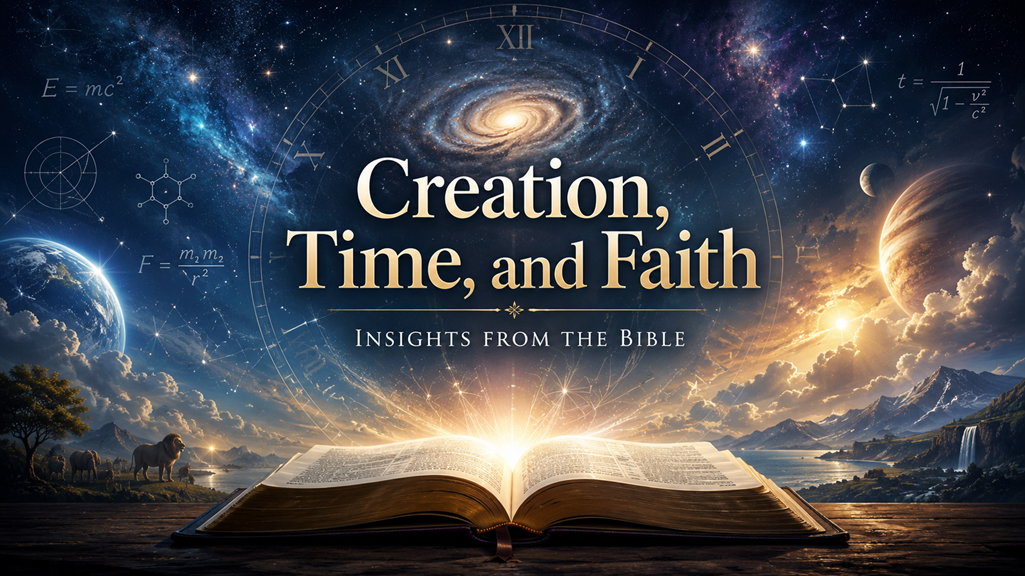
The wisdom of renowned physicist Stephen Hawking, as explored in his masterpiece, A Brief History of Time, presents a striking parallel with the spiritual truths articulated in the biblical account of creation. Hawking approached the universe through mathematics and theoretical physics rather than theology. Yet his search carried him to the same great boundary described in the opening words of Genesis: the beginning of time, space, matter, and the universe itself.
This does not mean Hawking's theories prove the Bible, nor does Genesis attempt to function as a modern physics textbook. The connection is deeper than that. Both science and Scripture confront us with the astonishing truth that the universe has not always existed in the form we know. There was a beginning, and that beginning forces us to ask questions that reach beyond ordinary human experience.
When Time Itself Began
We experience time as a steady movement from yesterday into today and from today into tomorrow. We remember the past, occupy the present, and wait for the future. Because this is the only way we have ever experienced existence, we naturally assume time has always been there.
Modern physics challenges that assumption. Einstein showed that time is not an unchanging cosmic clock. It is connected to space, motion, and gravity. Hawking carried that discussion into the earliest moments of the universe, exploring models in which our ordinary idea of "before" may no longer apply. Near the beginning, time itself may have behaved differently from anything we experience now.
Genesis opens with a simple declaration:
"In the beginning God created the heaven and the earth."
—Genesis 1:1
The verse does not say that God appeared in the beginning. It says God created in the beginning. The beginning belongs to creation; God stands beyond it.
From a biblical perspective, time is not an environment that contains God. Time is part of the created order. God is not merely older than the universe. He is eternal, existing independently of the clocks, calendars, and sequences that govern us. The Creator of time cannot be imprisoned inside His creation.
The Voice That Brought Creation Forth
Genesis next describes the earth as "without form, and void," followed by the command, "Let there be light." What was unformed became ordered. What was dark became illuminated. What had not yet appeared became visible through the word of God.
This is one of the most powerful ideas in Scripture: creation is intentional. The universe does not merely exist; it was called into existence. Before the stars shone, before planets moved in their paths, and before life appeared, creation existed within the purpose and knowledge of God.
Hawking studied the physical laws that govern the universe and attempted to explain how a cosmos could emerge through those laws. His conclusions about God differed sharply from the biblical account. Nevertheless, the laws he studied still reveal an ordered universe—one whose matter, energy, space, and time operate according to patterns that the human mind can investigate.
Physics can describe those patterns with extraordinary precision. Faith asks another question: Why is there an ordered reality for those laws to describe?
Science examines the structure of creation. Scripture points to the Creator whose wisdom gives that structure meaning.
Faith and the Unseen
Hebrews 11:1 describes faith as "the substance of things hoped for, the evidence of things not seen." Faith is not pretending to know what we do not know, and it is not an excuse to reject careful thought or scientific discovery. Biblical faith is trust in the character of God when our limited position prevents us from seeing the whole picture.
Creation itself provides a powerful image of this truth. Before a builder raises a house, the house exists as a design. Before an artist places paint on a canvas, the finished image exists in the artist's imagination. In a far greater way, the universe existed within God's intention before it appeared in physical form.
God did not discover creation as it unfolded. He did not experiment until something worked. The stars, the laws of nature, the earth, and humanity were already fully known to Him. His spoken command moved creation from divine intention into visible reality.
That is why faith is so important in our daily lives. We live inside time and can see only the moment we occupy. God sees what we call the past, present, and future within the completeness of His eternal knowledge. We often see an unfinished page; God sees the whole story.
A Thousand Years and a Day
Psalm 90:4 says that a thousand years in God's sight are like yesterday when it has passed. Second Peter 3:8 echoes that thought: with the Lord, one day is as a thousand years, and a thousand years as one day.
These passages are not mathematical formulas for calculating the age of creation. They reveal that God's relationship to time is fundamentally different from ours. Human beings measure life in seconds, years, and generations. God is not hurried by time, surprised by history, or anxious about the future.
This does not make our moments unimportant. On the contrary, the eternal God entered human history in Jesus Christ. The One beyond time stepped into time, lived among us, suffered, died, and rose again. The Creator did not remain distant from His creation. He entered it to redeem it.
The God who created time willingly subjected Himself to its passing. Jesus experienced childhood, hunger, weariness, waiting, suffering, and death. Through the Resurrection, however, He demonstrated that death and time do not possess the final word.
Creation began with God's command, and redemption continues through Christ.
Science, Faith, and Humility
The greatest lesson may not be that science and faith provide identical answers. They do not. Their methods and purposes are different. Science investigates measurable processes. Scripture reveals God's character, humanity's purpose, and the redemptive meaning of history.
The value comes when we allow both to produce humility.
Hawking's work reminds us that the universe is far more mysterious than ordinary experience suggests. The deeper scientists look into space, time, black holes, and the quantum world, the more they discover realities that challenge common sense.
Genesis reminds us that this mystery is not empty or meaningless. Behind creation stands divine intention, wisdom, and love.
We do not need to fear every scientific discovery, nor should we force each new theory into a Bible verse. Truth does not threaten God. Honest investigation can deepen our wonder, while Scripture keeps that wonder anchored in worship.
Science may help us understand how light travels, how stars form, how gravity bends space, and how time behaves under extreme conditions. Faith reveals why creation matters, why human life possesses value, and why the story of the universe is moving toward redemption rather than meaninglessness.
Living Inside the Created Moment
We live for only a brief moment within an immense creation, but our lives are held by the One who created the beginning and already stands at the end.
Our past is not beyond His redemption.
Our present is not outside His care.
Our future is not hidden from Him.
Faith does not require us to understand every mystery of the universe. It asks us to trust the One who does. We may not know what tomorrow holds, but tomorrow is not an unexplored place to God. He is already there, just as surely as He is present with us today.
Creation tells us that God has power.
Time tells us that God is eternal.
The cross tells us that God loves us.
Faith tells us that we can trust Him—even when we cannot yet see what He is creating.